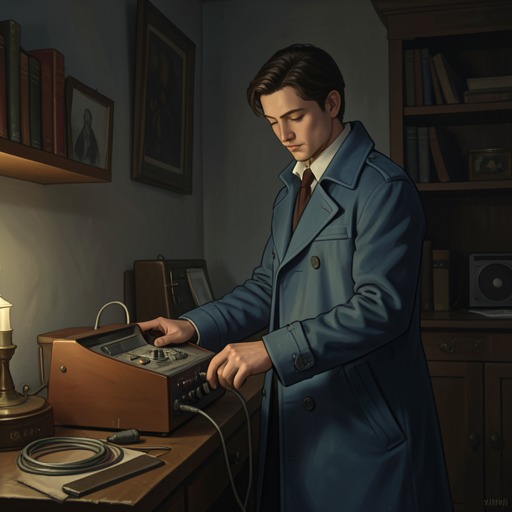
Werner Pfennig
All the Light We Cannot SeeWerner Pfennig’s talent for radio and mechanical invention gives him a way out of the coal-mining world in which he grows up, but it also makes him useful to the regime that recruits him. His story turns on that double consequence: the same curiosity that opens a world of signals and possibilities carries him into an institution that tries to replace questions with obedience, and eventually into military work. Radio remains both his technical specialty and a fragile means of reaching beyond the roles imposed on him.
Identity and Early Discovery
At eight, Werner Pfennig is an orphan living at Children’s House. While searching through refuse behind a storage shed with his six-year-old sister, Jutta, he finds a crude radio: a wire-wrapped cylinder between two pine discs, with frayed electrical leads and an earphone. He recognizes what the object is, and the discovery feels like a door opening. The radio is not yet a route to status or military service; it is an invitation to find out what lies beyond the immediate world.
Years later, at eighteen, Werner is a German private in a hotel occupied by soldiers. That later image gives the childhood discovery a stark frame: a boy fascinated by a receiver has become a young man inside the machinery of war. The intervening stages show how ability, poverty, and institutional ambition converge to carry him there.
Recruitment and the School at Schulpforta
Werner’s practical skill attracts Rudolf Siedler, who tells him that schools associated with General Heissmeyer offer working-class boys instruction in mechanical sciences, code breaking, and rocket propulsion. Werner objects that his family cannot afford such an education. Siedler presents the institutions as designed to recruit industrious boys from laboring backgrounds, and Werner is drawn toward the possibility of a life beyond the mines.
After Werner returns from Essen, a formal letter arrives at Children’s House, bearing an eagle and cross. It orders him to report to the National Political Institute of Education at Schulpforta. Werner receives the news in the orphanage parlor, among its cracked walls and sagging ceiling, and understands that he has found a way out. The opportunity is real, but so is its price: Schulpforta places his talents within a regime of discipline and ideological training.
In a practical exercise, the boys receive boxes of equipment and an hour to build a Morse-code circuit. Werner briefly recalls his habit of asking questions about natural phenomena and distant worlds, then quickly assembles an oscillator from a battery, sheet metal, nails, and an instrument hammer. When Dr. Hauptmann gives the class a second challenge, Werner makes a simple motor by joining a magnet, screw, wire, and battery. The screw and magnet spin within seconds. Hauptmann singles him out by name and asks what else he can make; Werner offers a doorbell, a Morse beacon, or an ohmmeter. His skill is not merely aptitude in the abstract: he can see how parts relate and turn a schematic into a working device with remarkable speed.
Technical Work and the Uses of His Talent
Hauptmann’s attention develops into sustained technical work. Werner calculates triangulation problems, picturing observers measuring the distance to a far-off landmark, and uses a slide rule to arrive at a result. In the professor’s laboratory, his work shifts between mathematics and engineering. Hauptmann asks him to improve a directional radio transceiver so it can be retuned rapidly across multiple frequencies and measure the angle of incoming transmissions. Werner reconfigures much of the design.
The work places him close to scientific ideas that excite him. At times Hauptmann explains components such as solenoids and resistors, discusses physics, or entertains Werner’s questions; at other times he becomes abruptly silent and closed. Werner is fascinated not only by the technical problems but also by the power surrounding them. Hauptmann’s telephone connects his office to influential men far away, and Werner imagines how quickly that authority could be turned against a city. The same technical network that promises discovery is already bound to military force.
The transceiver moves beyond the classroom: a company in Berlin produces units, some of which return from the field broken, burned, or otherwise defective. Werner rebuilds them while Hauptmann handles calls, replacement-part requests, and absences from the school. His contribution is practical and consequential, even when he does not see the full circumstances in which each device is used. His talent has crossed from making circuits for the pleasure of understanding them to maintaining equipment deployed by the state.
Home, Jutta, and the Pressure to Conform
Schulpforta trains its cadets to identify weakness and prizes rigor, exercise, and certainty. Werner sees how the boys become absorbed in this discipline, while suspicion gathers around him because he is an orphan, often alone, and speaks with traces of the French he learned as a child. The school’s atmosphere makes technical distinction a form of privilege, but it does not make him belong securely among his peers.
His private measure of home is more intimate. He misses rain on the zinc roof above his dormer, the energy of the orphans, and Frau Elena’s scratchy singing as she rocks a baby. He also misses the smell of the coking plant at dawn. Above all, he misses Jutta: her loyalty and obstinacy, and her capacity to recognize what is right. Yet the qualities he loves can also trouble him. In weaker moments, he resents her questions and wonders whether her resistance marks him as different from the cadets around him—or keeps him from surrendering fully to their outlook.
Jutta’s letters are heavily censored, and Werner’s own replies shrink to a few lines of reassurance that he is well and busy. He delays writing, then feels dread about that distance. The school’s doctrine of certainty directly conflicts with the questions Jutta continues to ask. Werner’s technical standing under Hauptmann protects him, but his protection and advancement are tied to the institution; neither restores the unguarded correspondence he had with his sister.
Late at night, Werner uses a Grundig tube radio formerly borrowed by Frank Volkheimer, searching frequencies for music or echoes without knowing exactly what he hopes to find. The search brings together fragments of his divided life: circuits breaking apart and reforming, Frederick absorbed in a bird book, the machinery of the mines at Zollverein, and Jutta moving with a torch as darkness gathers. The images link technical thought, industrial labor, friendship, and home, but the receiver offers no easy reconciliation among them. Static interrupts the search, and the question of whether anyone is listening remains suspended.
Refusal, War, and a Returning Signal
In January 1942, Werner goes to Hauptmann’s warm, firelit office and asks to be sent home, offering to work to pay his train fare. The request puts his desire to leave beside the comforts and privileges Hauptmann accuses him of receiving: concerts, chocolates, and warmth beside the fire. The contrast exposes the cost of Werner’s position. He wants to withdraw from the school, but the work and status that distinguish him also make that withdrawal difficult; in this scene, the request does not secure his return.
Later, as a soldier, Werner recognizes the voice of a French broadcaster through a burst of static. The voice’s Breton accent and the transmission’s quality recall broadcasts he heard before. A few words about the next broadcast come through, followed by a piano phrase. Werner covers the receiver’s meter with his hand and waits for Bernd to key his microphone, but the others appear to be asleep. The signal does not undo Werner’s participation in the system that has carried him from Children’s House into military service. It does, however, reconnect his technical present with an earlier life of listening and with a voice that crosses the distance between them.
Werner’s arc is therefore neither a simple celebration of genius nor a story of technical mastery untouched by politics. The radio first enlarges his imagination, then helps secure his admission to an elite school, becomes the focus of military engineering, and finally carries a familiar voice back through the static. His gift repeatedly opens doors, but the institutions on the other side shape what that gift is made to serve. The surviving moments of longing—for Jutta, for home, and for a signal recognized as human—show the distance between Werner’s capacity to build connections and the world that puts his skill to use.